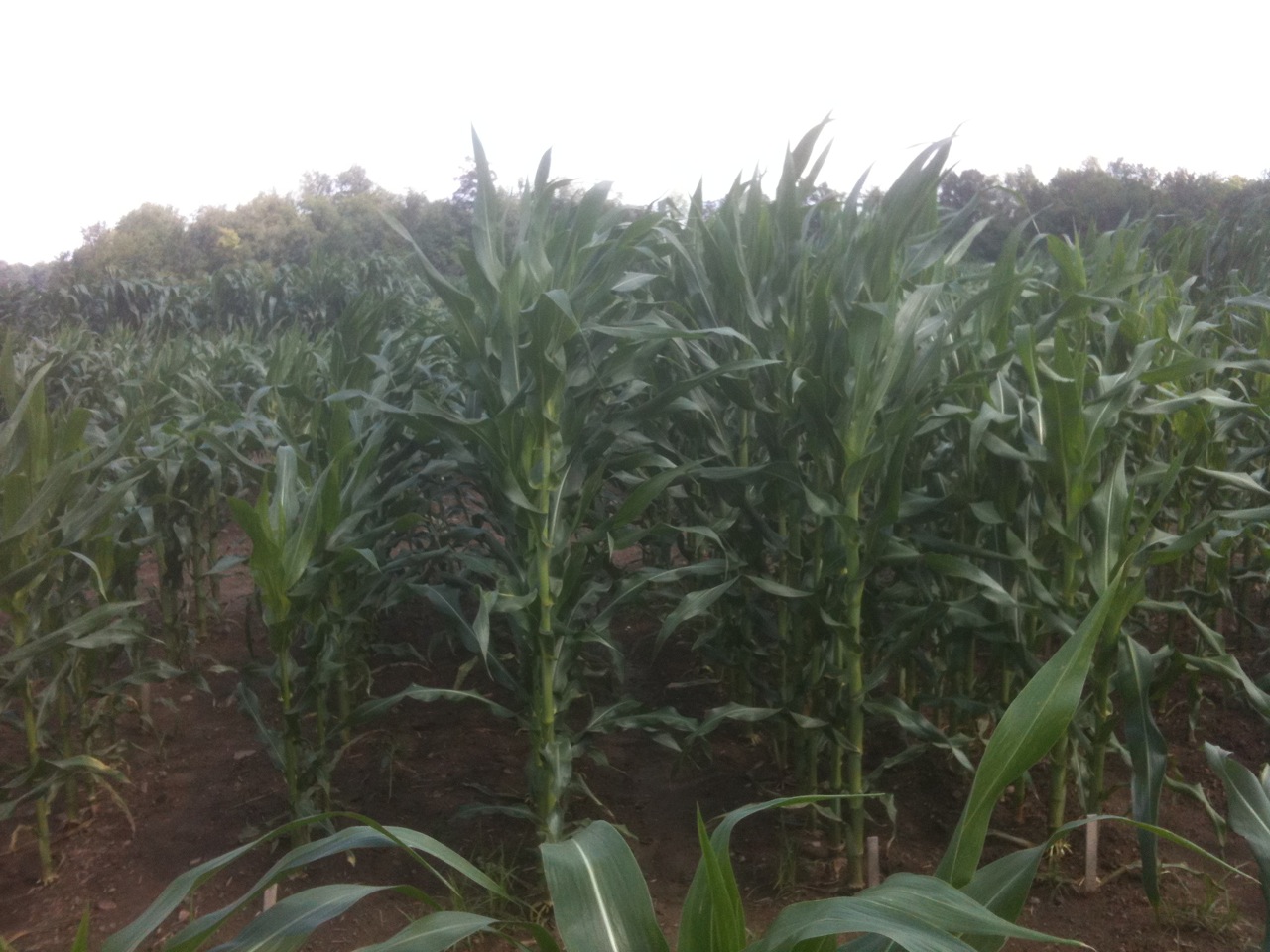
The Union of Concerned Scientists threw their usual wet blanket on the development. I think their gloomy assessment of transgenic drought tolerance is pretty biased but they do make a few good points that the public should understand. Primarily, "drought tolerance" does not mean that these plants can be grown with little to no water.
Showing posts with label Biofortified. Show all posts
Friday, August 24, 2012
Monsanto's GM Drought Tolerant Corn
The Union of Concerned Scientists threw their usual wet blanket on the development. I think their gloomy assessment of transgenic drought tolerance is pretty biased but they do make a few good points that the public should understand. Primarily, "drought tolerance" does not mean that these plants can be grown with little to no water.
Tuesday, January 31, 2012
Herbicide Resistant Johnsongrass: Coming soon to a farm near you!
Pioneer and K State are jointly releasing a set of new herbicide resistant sorghum varieties, which will incorporate resistance to ALS and FOP herbicides. Ironically, these non-genetically modified varieties invoke one of the classic bogeymen of anti-GM thinkers - herbicide resistant weeds.
Thursday, November 10, 2011
Practical Agricultural Development
Among plant geneticists, breeders are always held up as the pragmatic experts who know what matters in the Real World. But not all fields perceive breeders this way...
Sustainable agriculture was a popular session topic at the tri-societies joint meeting in San Antonio. More specifically, many speakers took pleasure (rightly so) in pointing out the subtle complexities of local agricultural systems that many of us in breeding gloss over when trying to help.
Some highlights:
Thursday, October 13, 2011
Genetic Engineering vs. Breeding
"Many administrators, private and public, have decided that the future of plant breeding lies in genomics, relying on claims that molecular genetics has revolutionized the time frame for product development. ‘Seldom has it been pointed out that it is going to take as long to breed a molecular engineering gene into a successful cultivar as it takes for a natural gene’" - Goodman 2002
Thursday, September 29, 2011
Blue Potato Chips
JetBlue airlines now gives out blue potato chips as their "official" snack.
I'm very impressed by the fact that these blue potato chips exist. It's no small feat to create a good-frying potato with excellent agronomic qualities in itself. I can't imagine crossing in blue coloring (anthocyanin expression) on top of this in a reasonable amount of time - especially since potatoes aren't true to seed. Non true to seed crops like potatoes have messy, highly heterozygous genomes that when crossed (or selfed) produce offspring that segregate for all the traits you care about. I've been told that potato breeders typically make a bunch of crosses in the first year of their program - and then spend the rest of their careers evaluating and propagating the resulting segregants asexually.
Though the chips really are purple, not blue...
Wednesday, September 21, 2011
Polycultures in Modern Ag?
The September issue of CSA news has a nice (open access) article entitled: "Do polycultures have a role in modern agriculture?"
Some key caveats:
Thoughts?
Some key caveats:
They conclude that polycultures are intriguing but definitely require more (agronomically realistic) research.
- While diverse plant mixtures have been associated with many benefits, high biomass yield (i.e. what farmers get paid for) is usually not one of them.
- It's very difficult to maintain complex plant mixtures - usually a single species will come to dominate.
- Our crop monocultures represent those crops that are best adapted to a given region.
- Establishing, maintaing and harvesting polycultures will require significant effort, risk, investments and training for farmers.
Thoughts?
Monday, September 5, 2011
Evolution of Fruit Shape in Tomato
Someday you'll be able to use CAD software to draw up what you want a plant to look like and the software (containing detailed growth models) will tell you what genetic constructs you need to bring it into the world...
But for now we barely understand how natural morphological variation is controlled. So I was excited to see this paper out of the van der Knaap and Francis labs. In it, they review some of the known levers by which tomato plants control fruit shape and investigate their historical appearance.
Monday, June 13, 2011
What's Cooking, Uncle Sam?
I just went to the new "What's Cooking, Uncle Sam?" exhibit at the National Archives. It tells the history of the government's role in U.S. food and agriculture - a story of market protectionism, social engineering and the regulated tension between the aspirations of business and the demands of the people...
Friday, May 13, 2011
Commercial Perennial Crops?
The "perennial grain" story seems to pop up every few months. The basic idea is that perennial crops would have higher yields and lower environmental impacts than their annual kin.
The picture on the left explains pretty clearly why - large permanent root systems secure the topsoil, exhaustively scavenge water and nutrients and support more vigorous shoot growth over a longer season.
This week, it's perennial maize.
The picture on the left explains pretty clearly why - large permanent root systems secure the topsoil, exhaustively scavenge water and nutrients and support more vigorous shoot growth over a longer season.
This week, it's perennial maize.
Wednesday, April 20, 2011
Ketchup and the Future of GM Food
It's 3 am local time and I'm wide awake, fixated on the challenge of brand differentiation in ketchup...
I recently spoke with one of the ketchup tomato breeders I know. Among other topics, he lamented the consumer's irrational fixation on price. He pointed out that most of us won't hesitate to grab a generic bottle of ketchup over a trusted brand for a difference of only 20 cents - which breaks down to no difference over the months it sits in your fridge: How do you sell a better product to a customer who's not willing to pay 1 cent more per week?
Monday, April 11, 2011
Heirlooms are Obsolete
"Heirlooms were varieties that were so unsuccessful that they wouldn't be sold today...
Every product declines until it's replaced by new heirlooms."
The backlash was inevitable.
Every product declines until it's replaced by new heirlooms."
The backlash was inevitable.
Tuesday, March 22, 2011
Better Chemistry Through Breeding
I recently had the opportunity to visit the fabled heart of the USDA-ARS empire: Beltsville.
I heard all about the tornado that knocked down all the campus trees, smashed in the greenhouses and threw doors down hallways a few years ago, visited their food sensory lab (a controlled environment where fruit samples are passed through a wall to waiting taste testers), and saw greenhouses packed full of cacao (where research on one of my favorite fungi, Crinipellis perniciosa, is co-funded by M&M Mars Inc.).
But I was there mostly to visit the pepper breeding program.
Sunday, February 27, 2011
Transgenic Papayas, Take 2
I must have been busy last year when Genomic Gastronomy tried to engage my post on transgenic papaya because I didn't really give much of an answer...
So with apologies, here's more!
Saturday, February 19, 2011
GM Vegetable Oil
Hooray for Seed Today helping me to clear another story out of my "drafts" folder!
How GM Overcame Soy's Fatal Flaw
It's an exciting time in genetic engineering! I've long been bored by the simplicity of our contemporary transgenic crops and the single-minded focus on agronomic traits. Dropping in an herbicide or pest resistance gene is good for the environment and the farmer, but it doesn't visibly benefit the consumer very much and just doesn't impress me technically. Now, Monsanto and Pioneer's new soybean varieties are heralding a new era of more sophisticated metabolic engineering of traits that will directly benefit the public.
Wednesday, February 9, 2011
Is Science Getting Harder (or just more social)?
A recent blog post over at the WSG asks if it's getting harder to discover new things:
"If you look back on history, you get the sense that scientific discovery used to be easy. Galileo rolled objects down slopes. Robert Hooke played with a spring to learn about elasticity; Isaac Newton poked around his own eye with a darning needle to understand color perception. It took creativity and knowledge to ask the right questions, but the experiments themselves could be almost trivial. Today, if you want to make a discovery in physics, it helps to be part of a 10,000 member team that runs a multibillion dollar atom smasher. It takes ever more money, more effort, and more people to find out new things."
Monday, January 3, 2011
US [transgene?] Testing Network
"With over 80% of the corn grown in the US genetically modified, and biotechnology companies phasing out non-GMO corn seed varieties, American farmers have fewer choices for finding non-GMO seeds to grow.
As a result of this narrowing of farmer choice, a new initiative was launched in 2009 by Practical Farmers of Iowa (PFI) to address the problem. The US Testing Network (USTN) aims to develop and introduce new non-GMO corn hybrids in the market, while improving the quality and quantity of non-GMO corn hybrids available."
I haven't heard of any of these organizations before (and would be interested if you know something about them), but it sounds like an interesting project. I couldn't care less about avoiding transgenes, but I love the idea of small companies, public sector scientists and enthusiastic individuals working together to improve germplasm for niche markets too small for the big seed companies to serve.
Do you have any experience with these organizations?
Thursday, December 2, 2010
Maize is a Machine
This is why farmers like hybrid seed. The parents on the left and right are inbred lines that have been self-pollinated for many, many years.* The two rows of much bigger plants in the middle are simply their hybrid offspring - they grow faster, produce higher yields and are tougher in the face of unfriendly environments.
Thursday, November 11, 2010
Climate Change and the Importance of Maintenance Breeding
Variety IR8 is the original "Miracle rice" of the 1960s. This carefully-crafted variety has a stunted, semi-dwarf phenotype, which increases it's harvest index (the proportion of grain biomass to total biomass), and allows it to resist lodging (falling over into the mud), even when heavily fertilized. As with wheat, the creation of dwarf varieties of rice played a major role in the enormous yield gains of the Green Revolution.
But now it's in trouble!
Tuesday, October 5, 2010
Friday, August 20, 2010
Evolving Pesticide Resistance
Subscribe to:
Posts (Atom)