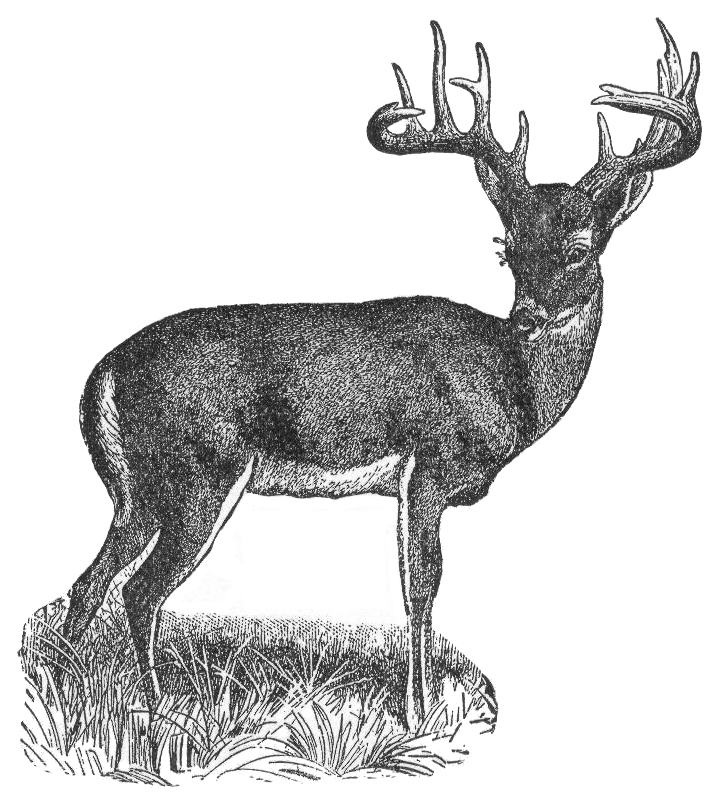
 I've enjoyed watching the seasons turn over in the meadows around my home. The fields are dominated by a resurgence of yellows and whites while roadside ditches are noticeably bare of pink and orange. The local fawns are losing their spots (and thankfully seem to be gaining caution around cars) while some bucks have sprouted velvety, 8+ point antlers.
This reminds me of a question I've always wanted to ask an intellectual vegetarian - "why?"
I admire those who make this big sacrifice in order to (profoundly) decrease their environmental footprint. Even a small decrease in meat consumption across the developed world would dramatically decrease agriculture's footprint.
I don't understand the moral argument though (as opposed to religious ones). Well, I do at first. It seems that all of ethics boils down to "it's wrong to hurt people." It's obvious and intuitive to extend this to animals, at least the more person-like ones.
A former professor of mine made the interesting observation that domesticated cats are obligate carnivores. Unlike dogs, cats can't be kept on a diet of rice and veggies. Does this mean it's unethical to keep cats as pets? I guess I could accept this corollary of vegetarianism, but it starts to lose me as I keep following it to its logical end.
Almost all vegetarians/environmentalists I've run into are big fans of reintroducing charismatic megafauna back into the wild lands our ancestors extirpated them from. The wolves of Yellowstone have been a particularly striking example. Biologists were amazed at the ecological transformation that followed the return of wolves. Wolves not only thinned out the overpopulated deer and elk herds, but created a "landscape of fear" that influenced where these herbivores travelled. Along streams, huge willow trees sprung up, spared from being browsed to the ground. Biologists hadn't even realized the willows were supposed to be there! Any Easterner who thinks hardwood forests are generally open and free of herbs and scrub have experienced this effect.
So if carnivores are required to maintain healthy and balanced ecosystems, why is it wrong for humans to participate? What difference am I missing between humans re-establishing wolves into Yellowstone and humans taking some of the prey directly? We're not really even an exotic species. Humans integrated into North American ecosystems after traveling over the Bering land bridge thousands of years ago, the same as any other major terrestrial carnivore.
I hesitate to wonder if the wolves are doing our "dirty work" for us. Most people don't hesitate to buy shrink-wrapped ham, but I don't know how many could bring themselves to kill and butcher a pig. I can't help but feel that vegetarianism might be a symptom of our disconnect with nature. No one likes death, but it's just the way this world works. We are part of the natural world, not foreign observers.
I'm especially concerned about the future ecological integrity of the eastern forests as the white-tailed deer population continues to explode. Much of this region is too densely-populated to re-establish wolves, mountain lions or bears and the number of U.S. hunters is cratering. What's the solution? Am I missing something?
Ultimately, it may be too much to ask people to explain their ethics. I'm reminded of a thought experiment that demonstrates how illogical morality is. Paraphrasing:
Imagine you see a speeding train. You know that if it continues on its track, it will kill 50 workmen around the next bend. If you throw the track switch in front of you, it will divert the train so it only kills 1 man. What would you do?Most people would say "yes" to the first and "no" to the second, and most couldn't tell you why.
Now imagine there are still 50 men around the bend but there is no switch, only a man working near you. If you shove him in front of the train, it will stop before killing the other 50. What would you do then?