Sunday, June 6, 2010

Gardening a Forest

I grew up (mostly) in an old farmhouse in Delaware. The three foot thick stone walls that make up the core of the house are probably 200+ years old, and from the basement, you can see that the main floor is supported by whole, rough-hewn tree trunks. The farmland was bought up and developed before I was born, but field stone walls and small building foundations are still present, scattered in the surrounding acres of private and state land.

Mirroring a century-long trend that has occurred throughout the Eastern U.S., the original farm was abandoned and now-maturing secondary forests grew up in its place. The U.S. now has more forest than anytime since European colonies were established.

The forest on and around my parents' property is in decline. The suburbanites have been neatening up the woodlots that snake between all their plots, cutting down ugly and dangerous trees and preventing the re-establishment of many seedlings. Many of the largest trees are falling now. The pro arborists say the giant boulders half-hidden in the soil compromise the trees' hold, and I imagine the loss of their neighbors increases windthrow.

Wednesday, June 2, 2010

Anthesis

Anthesis = flowering.

This term is used a lot with grasses (e.g. grains) to denote when the anthers poke out of the bracts to release pollen. I grabbed this example at the end of a run. A bunch of the anthers fell off already, but their bright yellowness was striking - especially en mass on the roadside. I've seen few grasses with such dramatic flowers.

Tuesday, June 1, 2010

New running route, New plants to learn

I just went for a walk along the country road I now live off of (this one's paved). It'll make for a nice running route. It's lined by active ag fields (some run by the University) instead of fallow pastures and has a number of wildflowers and weeds that I already don't recognize. There are also at least 4 grasses, which I won't even attempt to ID unless I'm given reason to.

I was captivated by the tall, rippling roadside grasslands I saw in southern Virginia this past weekend (they reminded me of my childhood Plains - there were even some clumps of prickly pear!). I was all ready to post a rant blasting PA for their ugly, ragged mowed highway corridors when I climbed north into Harrisonburg and the tall grasses gave way to short ones and scrubyness - so I guess it's not just obnoxious landscaping's fault. I don't know if the soil/climate changed or the southern end of 81 is heavily seeded by the local pasture grasses (the ecoregion map provided few clues) but I'll hopefully have the presence of mind next time I'm down there to grab some flowers to ID.

I have the means: a 1935 copy of Manual of the Grasses of the United States.

Monday, May 24, 2010

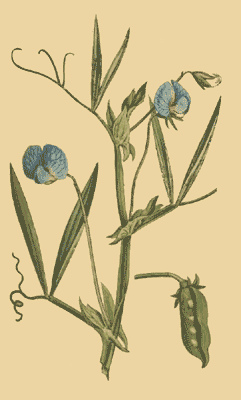
Beware the Grass Pea

There's been a big uptick in grass pea consumption in recent years - with accompanying paralysis (especially in children).

Grass pea (Lathyrus sativus*) is a crop of last resort. It's commonly grown from Southwest Asia through the eastern Horn of Africa, where it's mostly used as livestock forage. It has tremendous resilience in the face of environmental stress and pestilence and is often the only thing left standing after severe droughts and civil wars. Grass peas taste good, are full of protein, can grow in terrible soil and fix nitrogen, however, they also produce a potent neurotoxin, ODAP, which causes paralysis of the lower limbs when consumed in excess over extended periods.

It's a real tragedy, but thankfully it's one that science and crop biodiversity can do something about.

ICARDA, a research station of the international agricultural science organization, CGIAR, is working on screening germplasm from all over the region to find locally-adapted landraces with very low levels of ODAP. When I first heard about this story, I wondered why they didn't just use mutation breeding or genetic engineering to knock out the toxin altogether instead of just trying to find low-toxin ones, but apparently the toxin plays an important role in the grass pea's stress tolerance.

It's a pretty simple project that could make a really big difference.

*Sweet pea is in this genus

LinkWithin

Related Posts with Thumbnails